Ugh, man, I like never update this thing.
I know that one reason for this issue is that I'm scared that my tone will waver and be inconsistent here. I mean, I've blogged consistently on more personal diary-esque ones ever since high school, so I'm certainly no stranger to blogging, but here the association with some industry makes the stakes and expectations higher. Since this is a blog that is linked to my work, and therefore kind of a professional thingy, there's a level of formality and distance I feel is expected and required. This should be treated like one of those update post blogs, where you reassure your reader base about consistent progress or announce some hiatus thanks to real life stuff, or maybe treated as one of those editorial-esque soundboard blogs for my thoughts on stuff happening in the industry. This is no place for emotional outpourings or disordered ramblings, or heaven forbid the interjection of petty personal drama.
There is also the fact that, unlike my obscure personal blogs, this blog is linked to my portfolio website. If I ever finish my game, it will also be linked to that as well. It is bound to have a stray pair of eyes chance upon it, quite possibly an important pair of eyes, skimming and formulating an idea of the potential professional I am from the text presented. Shouldn't I then keep the tone consistent to help with the generation of this persona? Shouldn't I be assuming a professional no-nonsense tone that relays relevant information on the project as efficiently and curtly as possible? Shouldn't I present myself in the best light possible, in the visage of that great, passionate, motivated and on-top-of-things sociable developer? I know though that this consistent, reliable and noteworthy persona that hem such portfolio blogs is one that I cannot sincerely lay claim to.
I am a flawed human being with a lot of room for improvement. I am driven by anxiety, highly emotional and impulsive. I waver between productive and destructive states. I am still green and immature, frequently forgetful of the divide between what I presume and what actually is. I like waxing pseudo-philosophical and pondering and speculating, to the detriment of productivity. I am also highly flaky and a perfectionist marching to a markedly different beat. Those who really know me know how unreliable I can be. To those that do not know me, I no longer feel like posturing to be polished and responsible, of bearing the persistent anxiety of uglier colors peeping out.
I am tired and sorry of feeling like I am lying all the time, especially when those who know this uglier side already are bound to come across this faux facade. I am, simply put, flawed, and it is my selfish hopes that by embedding the values I've disregarded for so long into something I revolve my life around, personal projects, that I will come to incorporate those traits into my own life and redeem myself as a human being. I wish to take these values into account and show my respect for the people around me properly. But this is not an effortless endeavor for me, and I do not feel like pretending it will be.
I do not feel like story-fying or glossifying this project with promises of a steady stream of inspired, productive update posts, of wondrous revelations and dashing triumphs over setbacks, of great innovation or even of completion. The least I can attempt to do is aspire for transparency. I want to record more earnestly and truthfully the mental journey I've been going through to generate the story at its current place. I want to be able to look back and see how the messy naive real me scrambled about. I want to catch and share the moments when something inspired me, when something clicked and an underdeveloped aspect of my project suddenly came into focus. I want to be able to jot all of this down here without regards of how out of place, ADD or unrelated it may seem.
I want to be able to look back and see where I veered off. See the places where real life caught up with me and kept me unable to do anything for a while, or the places where I sat stagnant with nothing really going anywhere. I want to see the places where my weaker points of ignorance, bias and misinformation led to painful stupid moments and the ways those moments humble and inform me. I want to present a preservation of the full process I engaged in, and I feel I owe this to whoever stumbles upon this thing of mine.
All that being said, I want to say that, at this point in time, I am nearing the end of my first semester as a transfer student at NEU. I was dumb, and I was right: four classes was too much for the current me, especially with lab on top of that. I am really happy that I am nevertheless able to consistently and reliably help my brother with his coding hw. Like, really happy. Regardless of how this semester turns out, I will look back fondly on the ways I helped my brother catch onto for-loops and structs and all the lots of many bugs.
It is dumb, but I keep on veering off and thinking about stuff for this project when attempting to do my classwork. My mountainload of classwork. All it takes is a little glint of potential material, some little seed in my reading or project that could lead to some new idea for the game, and I find myself lost on a crazy tangent. It's ironic (and ridiculous) that a game on self-control is itself being a major source of temptation. I want to write more frequently here (I have plenty of stuff to talk about), but until the semester ends, I need to control myself and shelf actual work on the project for now. I look forward to December 4, when the time to engage and the muse of winter are mine to claim again.
Friday, October 24, 2014

Wednesday, February 26, 2014
It was Always in the Back of my Mind
What is up, blog?
Wow, it has been too long since I've posted here. Never fear, I have not abandoned my game. In fact, I have new arts scattered throughout this post to keep your eyeballs somewhat engaged. I feel that the juxtaposition of different concepts this challenge presents has helped me to see and stumble upon and think about ideas and phenomena I would otherwise never have encountered, so even if I were to never actually bring a game to fruition, I would have more than enough interesting stories and discoveries to share. I am the obsessive type, the type that gets completely suckered into a fandom, a research topic, and more importantly, a personal project, so this game idea has literally haunted my every thought for the past, I think, 2-3 years? The degree of my obsession has gone so deeply that themes of ice and the color red literally pervade my dreams on a semi-regular basis now. I am doing research even in my dreams; one of my dreams this past week involved me approaching one of numerous gigantic weird glacier-things scattered around an old mining-based town the class was visiting, and prying off a piece to study the way the colors shift and absorb light at different angles, so I could better understand how to capture its essence visually. My dream self will literally grow excited when it finds an inspiring shade of red or happens upon a snowy bank, or consciously note if some event in the dream world would be an interesting addition to the game.
Well, by divulging the depth of the challenge's impact on even my dreams I am not implying that this obsessive tendency is a good thing, and I definitely know it has no bearing on my actual progress with my game. But it is nice to know that, even when asleep, my brain naturally starts processing and playing with all the cultural bits and pieces I've discovered regarding the cards I've drawn. Dreams have become particularly useful in formulating a unique and personal aesthetic for the game, and though my abilities to translate that into digital form may be limited, some of that essence will definitely persist. I am also especially lucky this winter, since a variety of releases and events have been providing me with even more opportunities for aesthetic inspiration. Frozen has been excellent in teaching me how to catch the enchanting, soothing heavy wash of pink that casts over the snow at dawn and sunset, and Sochi has provided me with many examples of inspiring, strong female leads. And though I know that with the cold comes great discomfort and danger to the homeless, I could not help but glean inspiration from the weeks of snow and ice that cast upon Atlanta twice. Of course, I would rather that not happen again; I could get more out of a skiing trip than that without endangering anyone.
Anyways, what I want to say is that during all this time, I have been collecting bits and pieces, turning them over in my head and fiddling with them, gaining insight into things I never knew, and slowly pulling together a blueprint for a game that can naturally encompass all the elements of ice, red, tact and self-control. Oh, I should probably mention that with progressive research I've decided that the terms 'tact' and 'self-control' more accurately encapsulated the essence of the original words I drew, which were 'diplomacy' and 'self-discipline,' but that's info I can cover more in depth in another post. I know how I want to present these pieces now, and I know the basic narrative and mechanics I would use to do just that. Now that I have a high-concept idea of how to present a game encapsulating abstract terms, though, it's time I stepped back and whittle down the idea into something that I am actually capable of building.
First, though, I would like to talk about the full extent of the idea I've built up. Ideally, if I had a magic wand, I would create this game set in a 3D enviro, inspired by works by guys like Timothy Reynolds. It would be navigated by clicking upon objects and persons, which the mouse would naturally snap to. You would not really walk around the place like you would in a standard adventure game, because the game would be simulating how an extroverted social person sees the world. The mouse is therefore your only and primary means of navigation, and it is representative of your proximity to certain things in the room. If your mouse is close to the gossipy housewives in a corner, you would consequently pick up bits and pieces of their conversation. Move the cursor closer to the younger clique in the corner, and you'd overhear that group's gossip. Click the clique and obviously you'd be interacting with them. You make true narrative progress in the game by the information and interactions you unlock with people, and the key to do just that lies in how you've been spending your time each day. If you've been doing your homework, then you'll be able to better communicate with your professors, and therefore comprehend and be able to ask questions pertinent to the overarching narrative.
Okay, cool, so obviously this whole people-interaction thing covers the tact card. Calling the professor a fatty is clearly a tactless move, and commenting on the implications of blah blah blah smart stuff with the guy a whole lot tactful. Now we need to cover self-control.
Self control would come in by using your standard old 'here's a list of stats, level them up!' system. It would be a bit like the Sims. Click that treadmill: five minutes later, oh look, your Sim's Athletic stat went up! Here is where my interpretation of self-control would come in to differentiate it, though. When you make Sally get on that treadmill, you don't just sit there and wait for her to loop through her running animation until Athleticism goes up to Level 4. There are going to be some major Mental Hurdles that pop up! Sally is, just like most people, not always going to be in control of herself. That means that if she feels lethargic and tired of feeling sore all the time, she may autonomously step off that treadmill and beeline for the couch. This negative state of mind is reflected in negative note clusters, and the only way to counter them is to play note clusters representing positive ideas. There is also a goal/motive window thing, and if it happens to be fuzzy and fading away, chances are her stamina and will are not going to hold up very well. Play those positive notes well enough and on tempo, and that goal may come into sharper focus for her. (There is a reason I'm using music as a means of controlling mood, but that would be something for a later post).
Something else that I'd want to implement in the name of Self Control is a feature for habits. It would be painfully tedious if you had to do the whole note-playing rote series of task-clicking every single day. The key is in doing something, like running at 5pm every other day, regularly enough that Sally cannot help but start autonomously doing it every day. When something becomes a habit, happy buzzy feel-good special effects and musics pop out at you and instead of making you sit there while she runs, it skips through the action and summarizes it, otome-style.
Here's an example from an otome called Love Revo:
If she has a full routine of habits going on, then you've got some serious pumped up music sequence stuff going on, with all these cool graphic success-indicative panels flying at you. You also end up saving time. None of this is fixed, though. While she walks off that treadmill and heads towards the easel to, I dunno, practice painting like she usually does, you can cancel that and make her walk over to the guitar instead, and switch up her routine. As she becomes comfortable enough with various types of tasks to form habits with them, her stamina also levels up, and picking up a related habit (like learning drums after learning guitar) is far easier and accessible.
Obviously this is all very abstract, conceptual, Babel-y stuff, and whether it actually would be enjoyable is something that I really cannot predict. Whether I can actually implement it is also another matter. I feel that this model does encapsulate tact and self-control, though, and while I definitely won't be implementing all the particulars of what I've just described, I'll be taking the general ideas presented and placing them inside a less ambitious, conventional framework (like a top-down pixelly RPG). I have been taking an AI class this semester and, um, I am made all the more aware of how inexperienced and noobish I still am. I have wanted to try and implement it in Unity, but my mind draws delusions of amazing soft, crystalline shaders lovingly drawing sophisticated, life-like NPCs on screen, and well, reality check says that's not possible for me right now. Instead I'll be focusing on using Flash to build what is basically a dollhouse. I will have a single semi-autonomous AI roaming about a single-room house, and it will be surrounded with items for building habits and skills. I am debating on using Flixel or plain old Flash at the moment. I'm most interested in the Habit/Routine mechanic. If I could get just that part down, I would feel like I'd accomplished a major chunk of the challenge. If I succeed, I wouldn't mind just wrapping up the rest of the game into a standard otome.
Also, I've been doing a lot of (attempts) at digital painting this semester for lab, and as you can see I've managed to pull out a few more colored concepts of what the protagonist may look like. I think I pretty much have her face/hair down, but am still kind of struggling with her outfit.
Anyways, there are a lot of things I want to talk about regarding the past few years, and I plan on populating this blog with detailed info on all the interesting things my research has unearthed. Dry posts on the particulars of a speculative blueprint aren't particularly all that entertaining. A fun post I plan to do sometime soon is on the range of solely ice/snow/winter-based games out there at the moment, both commercially and less formally via Indie platforms or flash portals. I'll try to make it a habit to post here more regularly, probably every week. I am really teetering on the edge with Grad school at the moment, so I definitely can't do much on the prototyping end, but compiling all the research I've done into digestible posts should be fun and relatively easy. I have to keep my writing muscles nimble for that final master's thesis anyways!
Before I go: check out this ice-based game from the interwebz. It's simple and pretty satisfying to play:
Wow, it has been too long since I've posted here. Never fear, I have not abandoned my game. In fact, I have new arts scattered throughout this post to keep your eyeballs somewhat engaged. I feel that the juxtaposition of different concepts this challenge presents has helped me to see and stumble upon and think about ideas and phenomena I would otherwise never have encountered, so even if I were to never actually bring a game to fruition, I would have more than enough interesting stories and discoveries to share. I am the obsessive type, the type that gets completely suckered into a fandom, a research topic, and more importantly, a personal project, so this game idea has literally haunted my every thought for the past, I think, 2-3 years? The degree of my obsession has gone so deeply that themes of ice and the color red literally pervade my dreams on a semi-regular basis now. I am doing research even in my dreams; one of my dreams this past week involved me approaching one of numerous gigantic weird glacier-things scattered around an old mining-based town the class was visiting, and prying off a piece to study the way the colors shift and absorb light at different angles, so I could better understand how to capture its essence visually. My dream self will literally grow excited when it finds an inspiring shade of red or happens upon a snowy bank, or consciously note if some event in the dream world would be an interesting addition to the game.
Well, by divulging the depth of the challenge's impact on even my dreams I am not implying that this obsessive tendency is a good thing, and I definitely know it has no bearing on my actual progress with my game. But it is nice to know that, even when asleep, my brain naturally starts processing and playing with all the cultural bits and pieces I've discovered regarding the cards I've drawn. Dreams have become particularly useful in formulating a unique and personal aesthetic for the game, and though my abilities to translate that into digital form may be limited, some of that essence will definitely persist. I am also especially lucky this winter, since a variety of releases and events have been providing me with even more opportunities for aesthetic inspiration. Frozen has been excellent in teaching me how to catch the enchanting, soothing heavy wash of pink that casts over the snow at dawn and sunset, and Sochi has provided me with many examples of inspiring, strong female leads. And though I know that with the cold comes great discomfort and danger to the homeless, I could not help but glean inspiration from the weeks of snow and ice that cast upon Atlanta twice. Of course, I would rather that not happen again; I could get more out of a skiing trip than that without endangering anyone.
 |
| I personally don't really like this picture, but whatever. |
 |
| A full-body shot that isn't anatomically implausible! Yay! I really despise her sweater, though. |
Okay, cool, so obviously this whole people-interaction thing covers the tact card. Calling the professor a fatty is clearly a tactless move, and commenting on the implications of blah blah blah smart stuff with the guy a whole lot tactful. Now we need to cover self-control.
Self control would come in by using your standard old 'here's a list of stats, level them up!' system. It would be a bit like the Sims. Click that treadmill: five minutes later, oh look, your Sim's Athletic stat went up! Here is where my interpretation of self-control would come in to differentiate it, though. When you make Sally get on that treadmill, you don't just sit there and wait for her to loop through her running animation until Athleticism goes up to Level 4. There are going to be some major Mental Hurdles that pop up! Sally is, just like most people, not always going to be in control of herself. That means that if she feels lethargic and tired of feeling sore all the time, she may autonomously step off that treadmill and beeline for the couch. This negative state of mind is reflected in negative note clusters, and the only way to counter them is to play note clusters representing positive ideas. There is also a goal/motive window thing, and if it happens to be fuzzy and fading away, chances are her stamina and will are not going to hold up very well. Play those positive notes well enough and on tempo, and that goal may come into sharper focus for her. (There is a reason I'm using music as a means of controlling mood, but that would be something for a later post).
Something else that I'd want to implement in the name of Self Control is a feature for habits. It would be painfully tedious if you had to do the whole note-playing rote series of task-clicking every single day. The key is in doing something, like running at 5pm every other day, regularly enough that Sally cannot help but start autonomously doing it every day. When something becomes a habit, happy buzzy feel-good special effects and musics pop out at you and instead of making you sit there while she runs, it skips through the action and summarizes it, otome-style.
Here's an example from an otome called Love Revo:
 |
| Here you see the protagonist attempt a weight-reducing activity. The outcome is based on a stat called 'Info.' Once you initiate the activity, there's not much else you can do to control the outcome. |
 |
| Yay, something lineless! Also, I really need to work on rendering gems, that looks like an oversized gusher on her arm. |
 |
| What I come up with for the prototype is probably going to look like the now-defunct PlayFish social game Pet Society. Except the pet will be replaced with a person. Gosh, I hope that doesn't end up being weird. |
Anyways, there are a lot of things I want to talk about regarding the past few years, and I plan on populating this blog with detailed info on all the interesting things my research has unearthed. Dry posts on the particulars of a speculative blueprint aren't particularly all that entertaining. A fun post I plan to do sometime soon is on the range of solely ice/snow/winter-based games out there at the moment, both commercially and less formally via Indie platforms or flash portals. I'll try to make it a habit to post here more regularly, probably every week. I am really teetering on the edge with Grad school at the moment, so I definitely can't do much on the prototyping end, but compiling all the research I've done into digestible posts should be fun and relatively easy. I have to keep my writing muscles nimble for that final master's thesis anyways!
Before I go: check out this ice-based game from the interwebz. It's simple and pretty satisfying to play:
 |
| www.kongregate.com/games/Nitrome/ice-beak |
Sunday, May 12, 2013
My development plan! Also, a sketch!
Sorry about the lack of updates, blog! I've mostly just been trying to get back on top of everything, as I usually am, admittedly. I've been having stamina issues, meaning usually I'm not particularly productive after getting back from work, but I think daily exercise should take care of that issue! I'm trying to run at least half an hour a day, preferably in the morning before work. I'm also going to try and give myself a designated lazy-day, maybe on Wednesdays, where I can just sleep and do stuff as much as I want. One of my major problems has always been this tendency to have these spells of hyper-productivity followed by long periods of burnout. I think having a day where I know I can just kick back and relax will prove beneficial to my productivity in the long run, because it provides me with a weekly moment to recharge. I think it'll help me become more balanced, in addition to the exercise.
As for my current plan regarding the game, I'm kind of off-schedule at the moment. By this time I should be making concept art for the game, and finished with some kind of prototype. Admittedly during the past few weeks I've mostly been ruminating further on the story and sketching possible designs for the main character. Oh, I've also ruminated on how she might see the world and the kinds of underlying beliefs and ways of thinking that would drive her approach to life. After seeing the sheer amount of work that is going into my current project at work, I honestly doubt I'll be able to finish my current game before the start of fall semester. At any rate, I'm probably going to just ditch my current block schedule and just wing it for now. For the next few days, I'll be mapping out the mechanics of the game, so I can break different parts of the game into separate prototypes that can still be integrated easily into the main game. I honestly just do better when I have everything mapped and planned out; I'm actually a bit in hot water at work at the moment, because my code has gotten so messy. Since I need to remap and reorganize all my code for work anyways, I may as well do the same for this current game of mine.
Here are the boring steps I'll be taking to plan out how I'll tackle the game's development: haha, sorry if it doesn't make much sense. I'll probably explain what each step means later.
A - Higher-level game map
B - Module identification
C1 - Detailed feature mapping/ expansion
C2 - Priority denotation
D - Tool creation consideration
E - Feature parts breakdown
F - Classes Map
G - Task list
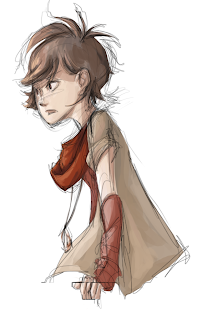
Anyways, have a concept sketch I made some time ago. I've been looking into birds associated with the morning like the lark and the american robin, as well as looking into winter fashion and fashion icons in general. I feel like the clothes I give my protagonists are limited by my own lack of knowledge, and I'm hoping that expanding my repertoire will allow me to design costumes that better reflect and augment my characters' personalities.
As for my current plan regarding the game, I'm kind of off-schedule at the moment. By this time I should be making concept art for the game, and finished with some kind of prototype. Admittedly during the past few weeks I've mostly been ruminating further on the story and sketching possible designs for the main character. Oh, I've also ruminated on how she might see the world and the kinds of underlying beliefs and ways of thinking that would drive her approach to life. After seeing the sheer amount of work that is going into my current project at work, I honestly doubt I'll be able to finish my current game before the start of fall semester. At any rate, I'm probably going to just ditch my current block schedule and just wing it for now. For the next few days, I'll be mapping out the mechanics of the game, so I can break different parts of the game into separate prototypes that can still be integrated easily into the main game. I honestly just do better when I have everything mapped and planned out; I'm actually a bit in hot water at work at the moment, because my code has gotten so messy. Since I need to remap and reorganize all my code for work anyways, I may as well do the same for this current game of mine.
Here are the boring steps I'll be taking to plan out how I'll tackle the game's development: haha, sorry if it doesn't make much sense. I'll probably explain what each step means later.
A - Higher-level game map
B - Module identification
C1 - Detailed feature mapping/ expansion
C2 - Priority denotation
D - Tool creation consideration
E - Feature parts breakdown
F - Classes Map
G - Task list
Anyways, have a concept sketch I made some time ago. I've been looking into birds associated with the morning like the lark and the american robin, as well as looking into winter fashion and fashion icons in general. I feel like the clothes I give my protagonists are limited by my own lack of knowledge, and I'm hoping that expanding my repertoire will allow me to design costumes that better reflect and augment my characters' personalities.

Monday, April 22, 2013
Yo
I just wanted to post a quick update: unfortunately I am really behind in tasks and promises I made to other people, so I haven't been able to do much for this game. I'm also going to need this week to get back on track again. Man, I feel kind of bad just slapping a really quick entry up like this (I guess that's why most people seem to gravitate towards Tumblr), but I'd really like to try and post weekly, to make it a habit. Blurgh. Anyways, I'm really hoping I'll finish everything by Friday, and then maybe this weekend I'll focus more on my prototype.
Tuesday, April 16, 2013
My Premise is about a Magical plot device
Man, my posts keep getting less timelier and timelier. Hmm, to be honest, I really wanted to have a strong grasp on the major plot points of the narrative by last Sunday, but I was still struggling to have a firm grasp on my premise and my protagonist's personality. I guess it's good I mostly focused on the actual game mechanics instead, because, well, to be honest a structured plot is not an integral part of any game. I mean, I believe that story, even in minimalist games like Tetris, will always be present (I'm not going to delve into that), but it is in my opinion subservient to the rules that make up the game. Anyways, what I am trying to say is that although I wasn't able to come up with a set plot by now, I feel like I was able to be fairly productive. I kind of found it impossible to think about the plot without thinking about how it could be told.
I really should have thought of this earlier, but 'Game Design' should have been the first thing on my list of 'blocks.' Then following that there could be Coding or Writing. Game design really does require a lot of thought, and I always took it for granted until I started tackling design problems at lab and at work.
Well, as of now the premise is as follows:
You are an undecided undergrad student just beginning summer classes following your first year. Thanks to your nonchalant attitude you're in danger of getting booted out due to your atrocious grades, which has netted you an appointment with your adviser this morning. Much to your bewilderment (and relief) the whole campus is suddenly battered with snow and ice, effectively closing it down. Before you can kick back and relax, however, a strange child-like thing approaches you for help. And against your better judgment you find yourself compelled to help this strange child-thing get back home, launching you into a journey that will test your will and wit.
I'll probably just stick with this premise for now. I mean, Super Mario Galaxy had a ridiculous premise, and it ended up being insane-awesome. What I really wish I could do, however, is craft a story that naturally arises from the conflicting interests of the story's characters. I mean, right now I pretty much just have a plot device/ magical person fall from the sky and 'spur the heroine into action.' Which is painfully overdone. When the story is the product of a rich world with rich, multifaceted characters, then even the simplest story from that world can feel extraordinarily immersive and compelling.
One recent game I've played that really brought this aspect to my attention was the HTML5 game 'no-one has to die.' by Stuart Madafiglio. Oh, man: it's so simple, yet the way the narrative reveals itself through the motivations of each of the characters is just thrilling. It's a game that, counter to what I said earlier, builds itself around the central narrative. The mechanics are there to dictate how the story unfolds before you: you may still have great autonomy, but the game still holds control over the story's pacing and delivery. Everything is insanely simple. But that tightly-woven narrative and its delivery just really make this something else! It doesn't take long to play, so if you haven't played it and have time to kill it's definitely something to check out. ^_^ Many of its fans seem to compare it to 999: I'll have to check that out sometime.
Hmm, anyways, my priority with this game is to first and foremost just get it done. And of the various aspects I could focus on, I would say that creating an interesting, somewhat-novel game mechanic is priority for me. Some of the most memorable games for me (Earthbound, Phoenix Wright, Gregory Weir's the Majesty of Colors) had extraordinary writing, but if I don't have working code then I can't really present a story, no matter how awesomely-well crafted I may think it is. Right now I am working on drawing up a very lengthy list of all the features I'd love to include in a shiny, idealized, unrealistic super-version. After that, I plan on stripping that list down to its absolute bare minimum. I'll then break that minimum down into milestones, and try making just a bunch of little prototypes.
One of the things I've (very quickly!) learned at work is that you should code as stupidly simply as you can. Because you can always just go back and clean up/append to it later. If you try to architect out some perfect framework from the get-go, it can bite you hard later on, because the code has already lost some flexibility. So unlike my first attempt, where I tried to start backwards and make myself an editor, I'll be doing quick and dirty prototypes. My hope is to have at least one working and playable by the end of this week. Oh, also, lab has basically ended for me today, so I'll have more time to spend on prototyping as well.
I really should have thought of this earlier, but 'Game Design' should have been the first thing on my list of 'blocks.' Then following that there could be Coding or Writing. Game design really does require a lot of thought, and I always took it for granted until I started tackling design problems at lab and at work.
Well, as of now the premise is as follows:
You are an undecided undergrad student just beginning summer classes following your first year. Thanks to your nonchalant attitude you're in danger of getting booted out due to your atrocious grades, which has netted you an appointment with your adviser this morning. Much to your bewilderment (and relief) the whole campus is suddenly battered with snow and ice, effectively closing it down. Before you can kick back and relax, however, a strange child-like thing approaches you for help. And against your better judgment you find yourself compelled to help this strange child-thing get back home, launching you into a journey that will test your will and wit.
I'll probably just stick with this premise for now. I mean, Super Mario Galaxy had a ridiculous premise, and it ended up being insane-awesome. What I really wish I could do, however, is craft a story that naturally arises from the conflicting interests of the story's characters. I mean, right now I pretty much just have a plot device/ magical person fall from the sky and 'spur the heroine into action.' Which is painfully overdone. When the story is the product of a rich world with rich, multifaceted characters, then even the simplest story from that world can feel extraordinarily immersive and compelling.
One recent game I've played that really brought this aspect to my attention was the HTML5 game 'no-one has to die.' by Stuart Madafiglio. Oh, man: it's so simple, yet the way the narrative reveals itself through the motivations of each of the characters is just thrilling. It's a game that, counter to what I said earlier, builds itself around the central narrative. The mechanics are there to dictate how the story unfolds before you: you may still have great autonomy, but the game still holds control over the story's pacing and delivery. Everything is insanely simple. But that tightly-woven narrative and its delivery just really make this something else! It doesn't take long to play, so if you haven't played it and have time to kill it's definitely something to check out. ^_^ Many of its fans seem to compare it to 999: I'll have to check that out sometime.
Hmm, anyways, my priority with this game is to first and foremost just get it done. And of the various aspects I could focus on, I would say that creating an interesting, somewhat-novel game mechanic is priority for me. Some of the most memorable games for me (Earthbound, Phoenix Wright, Gregory Weir's the Majesty of Colors) had extraordinary writing, but if I don't have working code then I can't really present a story, no matter how awesomely-well crafted I may think it is. Right now I am working on drawing up a very lengthy list of all the features I'd love to include in a shiny, idealized, unrealistic super-version. After that, I plan on stripping that list down to its absolute bare minimum. I'll then break that minimum down into milestones, and try making just a bunch of little prototypes.
One of the things I've (very quickly!) learned at work is that you should code as stupidly simply as you can. Because you can always just go back and clean up/append to it later. If you try to architect out some perfect framework from the get-go, it can bite you hard later on, because the code has already lost some flexibility. So unlike my first attempt, where I tried to start backwards and make myself an editor, I'll be doing quick and dirty prototypes. My hope is to have at least one working and playable by the end of this week. Oh, also, lab has basically ended for me today, so I'll have more time to spend on prototyping as well.
Monday, April 8, 2013
Blah blah mechanics and Story
Yo, blog! (^_^)/)
Sorry about the lack of a post yesterday. Aha, I admittedly have a slight phobia of cars (which is made all the more ironic by the fact that my brother was practically born a car fanatic), and I spent 3 hours on the highway. Needless to say I was pretty shaken afterwards, and I ended up sleeping for the rest of the day, lol.
Anyways, for the past week I've mostly been ruminating on the character, as well as on game mechanics. Unlike with more traditional, linear formats, I can't just start sitting there visualizing the whole storyline in my head. In fact, there shouldn't really be a single story line. The way you construct the narrative your player experiences needs to be informed to some degree by the way you plan on presenting said narrative. You also need to take into account the fact that you are not the sole storyteller anymore. By giving the player some control over something in your digital creation, you are giving him a voice. Even if your game is a purely linear RPG full of cutscenes, just the duration of time the player takes between each cutscene can color the way he sees the characters and views the narratives. To really make the most of this collaborative aspect of narratives in games, you need to break the story you want to tell into numerous little elements, and then have the game's programming, your direction and the player's choices ultimately bring the narrative together.
With that mind, one of the first things I tackled was how I planned on having most of the narrative play out. How would the protagonist traverse the many possible points in the game's narrative world to ultimately reach her goal? More importantly, how would this mechanic reflect discipline or diplomacy? I really want to stress the intricacies and nuances involved in talking to and getting to know other people a la diplomacy, so the major mechanic I want to stress involves talking to the NPCs around you. By talking to them you then uncover narrative clues and gradually get closer and closer to the end goal. I'm hoping that it will be a mechanic that the player naturally gets. Rather than having a jarring cutscene offer another spoonful of the story, I want the player to feel like they are piecing together all the pieces together themselves from place to place, and I want them to catch onto the idea naturally as well.
I'm hoping to implement a UI system that stresses the importance of the people around you, as well as compels the player to try and interact with them. I also want it to reflect not what a camera mindlessly sees, but us, through the filters of our mind's eye. When we enter a room we don't automatically take in every detail in HD indiscriminately. If we're hungry, our eyes will gravitate and focus on any food in the room. If we enter worrying about an algebra test, numbers will predominantly fill our heads, and only the bare details needed to traverse the room to our seat noted. And if we enter the room interested in what someone in that room might know, we scan faces closely, analyze what kind of person they might be from their body language, have mental markers highlight the ones we are close to. I want the UI to reflect that kind of internal processing. For now I'm considering having tags with the character's profile-pic pop up around a focal area defined by the mouse position. Clicking on the tag will bring up some info on that person based on what our perceptive protagonist was able to pick up by body language alone, and then clicking on it again will open up a dialogue between the protagonist and that character. I actually haven't considered how a group conversation would work, so I need to ruminate on that for a bit.
I guess in a way the game is similar to a visual novel. I feel like in real life, when you move from point a to point b, like from home to school, that space of time between the two don't really get recorded. It's not particularly important to you. I mean, personally that space of time is very important to me, and it's where I get some of my more interesting ideas and thoughts from, but I feel for a more socially-inclined character like the protagonist her life would be structured more along the lines of flitting from person to person. I therefore don't intend on implementing a traditional player control scheme: you know, with the WASD and jumping and traversing tilemaps and whatnot. It will for the most part just be rooms full of people, and then talking one-on-one Fire Emblem style. Moving from location to location would probably just happen via map. In fact, everything could technically just happen via conversation. There could be a chauffeur you spoke with whenever you decided to move somewhere else, for example.
Okay, so I have a game system that involves talking to a string of people. What does this mean for the story? It means that in order for the story to keep moving forward, there need to be a series of questions. A reason for the player to talk to these random people. There's a big giant question, and then smaller ones that lead to small answers and more small questions. And by talking to people and picking up the smaller answers eventually those answers would build up into the ultimate answer. The story's resolution.
This means that in order to jump start the story, there needs to be something questionable that happens. Something that is obviously abnormal, like say, I dunno, a blizzard in the middle of July. I also need to make the protagonist's dedication to solving this abnormality believable. One of the things I'm really set on doing, though, is on making the protagonist transform into a self-disciplined character. Meaning at the beginning she's pretty... not-disciplined. After over-thinking and over-analyzing things like I usually do, I've broken down discipline into 6 smaller aspects:
I played around with the idea of having her cursed for some time. Maybe be mean and make her start melting when she starts letting herself go by gorging on sweets or ignoring schoolwork. Maybe make her cursed to die within a few days unless she finds the cure, or have everyone she loves encased in ice or something. Something that I want to reach players, above any other stupid preachy messages I have, though, is that all of us, even the most self-destructed, have the capability and power within us to stand up again, to gain the ability to call ourselves even remotely self-disciplined and be proud of ourselves. For now I want a glimmer of the protagonist's potential to become a better her than she could have possibly dreamed of to shine through to the player. So I've decided to give her a redeeming trait; she almost never makes promises and she'll snake her way out of commitments via clever wording, but when she does make a solid promise, she keeps it. And she doesn't break it. She's a bit younger than my original perfect bordering-on-Mary-Sue protagonist, and she's just begun settling into college, thanks to her promise to get a degree to her parents. Once the world freezes over, she'll find herself making yet another promise and inevitably committing to a problem that launches her into the main narrative.
Wow, I did not expect this post to be this long. Not to mention it is probably really boring and dry. I plan on playing around with this set-up a bit more and developing the characters and possible narrative threads a bit more. I feel I have a stronger idea of how all the themes of discipline, diplomacy and ice all converge with both the story and the gameplay, and I actually feel a connection to the protagonist, so I believe this will be the last major change this game will go through. And even if I look back and think that this idea is just retarded and stupid, I intend on finishing this iteration through to the end. That's a promise! (Har har, I'm so clever).
Anyways, have some exploratory character art! Oh, in the end I just decided to have her be a person. I did explore with making her a robot or a lark or a koala, but in the end I decided to just stick with human.

Sorry about the lack of a post yesterday. Aha, I admittedly have a slight phobia of cars (which is made all the more ironic by the fact that my brother was practically born a car fanatic), and I spent 3 hours on the highway. Needless to say I was pretty shaken afterwards, and I ended up sleeping for the rest of the day, lol.
Anyways, for the past week I've mostly been ruminating on the character, as well as on game mechanics. Unlike with more traditional, linear formats, I can't just start sitting there visualizing the whole storyline in my head. In fact, there shouldn't really be a single story line. The way you construct the narrative your player experiences needs to be informed to some degree by the way you plan on presenting said narrative. You also need to take into account the fact that you are not the sole storyteller anymore. By giving the player some control over something in your digital creation, you are giving him a voice. Even if your game is a purely linear RPG full of cutscenes, just the duration of time the player takes between each cutscene can color the way he sees the characters and views the narratives. To really make the most of this collaborative aspect of narratives in games, you need to break the story you want to tell into numerous little elements, and then have the game's programming, your direction and the player's choices ultimately bring the narrative together.
With that mind, one of the first things I tackled was how I planned on having most of the narrative play out. How would the protagonist traverse the many possible points in the game's narrative world to ultimately reach her goal? More importantly, how would this mechanic reflect discipline or diplomacy? I really want to stress the intricacies and nuances involved in talking to and getting to know other people a la diplomacy, so the major mechanic I want to stress involves talking to the NPCs around you. By talking to them you then uncover narrative clues and gradually get closer and closer to the end goal. I'm hoping that it will be a mechanic that the player naturally gets. Rather than having a jarring cutscene offer another spoonful of the story, I want the player to feel like they are piecing together all the pieces together themselves from place to place, and I want them to catch onto the idea naturally as well.
I'm hoping to implement a UI system that stresses the importance of the people around you, as well as compels the player to try and interact with them. I also want it to reflect not what a camera mindlessly sees, but us, through the filters of our mind's eye. When we enter a room we don't automatically take in every detail in HD indiscriminately. If we're hungry, our eyes will gravitate and focus on any food in the room. If we enter worrying about an algebra test, numbers will predominantly fill our heads, and only the bare details needed to traverse the room to our seat noted. And if we enter the room interested in what someone in that room might know, we scan faces closely, analyze what kind of person they might be from their body language, have mental markers highlight the ones we are close to. I want the UI to reflect that kind of internal processing. For now I'm considering having tags with the character's profile-pic pop up around a focal area defined by the mouse position. Clicking on the tag will bring up some info on that person based on what our perceptive protagonist was able to pick up by body language alone, and then clicking on it again will open up a dialogue between the protagonist and that character. I actually haven't considered how a group conversation would work, so I need to ruminate on that for a bit.
I guess in a way the game is similar to a visual novel. I feel like in real life, when you move from point a to point b, like from home to school, that space of time between the two don't really get recorded. It's not particularly important to you. I mean, personally that space of time is very important to me, and it's where I get some of my more interesting ideas and thoughts from, but I feel for a more socially-inclined character like the protagonist her life would be structured more along the lines of flitting from person to person. I therefore don't intend on implementing a traditional player control scheme: you know, with the WASD and jumping and traversing tilemaps and whatnot. It will for the most part just be rooms full of people, and then talking one-on-one Fire Emblem style. Moving from location to location would probably just happen via map. In fact, everything could technically just happen via conversation. There could be a chauffeur you spoke with whenever you decided to move somewhere else, for example.
Okay, so I have a game system that involves talking to a string of people. What does this mean for the story? It means that in order for the story to keep moving forward, there need to be a series of questions. A reason for the player to talk to these random people. There's a big giant question, and then smaller ones that lead to small answers and more small questions. And by talking to people and picking up the smaller answers eventually those answers would build up into the ultimate answer. The story's resolution.
This means that in order to jump start the story, there needs to be something questionable that happens. Something that is obviously abnormal, like say, I dunno, a blizzard in the middle of July. I also need to make the protagonist's dedication to solving this abnormality believable. One of the things I'm really set on doing, though, is on making the protagonist transform into a self-disciplined character. Meaning at the beginning she's pretty... not-disciplined. After over-thinking and over-analyzing things like I usually do, I've broken down discipline into 6 smaller aspects:
self-control ----- willpowerBasically, our heroine is lazy, indulgent, low-energy and apathetic. Her life consists of weaseling her way out of as much work as possible and extending her time spent in bed. She doesn't particularly care for anyone, and she doesn't see much point in getting worked up over anything. Life is kind of pointless for her, so she's just going to get as much pleasure out of her short time here on earth as much as possible. How do you get a character like that to get up and do something, much less tackle a problem great enough to spawn an epic worthy of a video game?
balance --------- consistency
reliability -------- responsibility
I played around with the idea of having her cursed for some time. Maybe be mean and make her start melting when she starts letting herself go by gorging on sweets or ignoring schoolwork. Maybe make her cursed to die within a few days unless she finds the cure, or have everyone she loves encased in ice or something. Something that I want to reach players, above any other stupid preachy messages I have, though, is that all of us, even the most self-destructed, have the capability and power within us to stand up again, to gain the ability to call ourselves even remotely self-disciplined and be proud of ourselves. For now I want a glimmer of the protagonist's potential to become a better her than she could have possibly dreamed of to shine through to the player. So I've decided to give her a redeeming trait; she almost never makes promises and she'll snake her way out of commitments via clever wording, but when she does make a solid promise, she keeps it. And she doesn't break it. She's a bit younger than my original perfect bordering-on-Mary-Sue protagonist, and she's just begun settling into college, thanks to her promise to get a degree to her parents. Once the world freezes over, she'll find herself making yet another promise and inevitably committing to a problem that launches her into the main narrative.
Wow, I did not expect this post to be this long. Not to mention it is probably really boring and dry. I plan on playing around with this set-up a bit more and developing the characters and possible narrative threads a bit more. I feel I have a stronger idea of how all the themes of discipline, diplomacy and ice all converge with both the story and the gameplay, and I actually feel a connection to the protagonist, so I believe this will be the last major change this game will go through. And even if I look back and think that this idea is just retarded and stupid, I intend on finishing this iteration through to the end. That's a promise! (Har har, I'm so clever).
Anyways, have some exploratory character art! Oh, in the end I just decided to have her be a person. I did explore with making her a robot or a lark or a koala, but in the end I decided to just stick with human.

Sunday, March 31, 2013
Robot, Sloth or Human?
One of the major problems I've had with all my past story treatments for the game was that the protagonist was very difficult to connect to. I mean, usually the writer can at least connect with the protagonist because they project themselves in the character to some degree or another. But here even I couldn't really connect to the protagonist.
Self-discipline is an extraordinarily empowering trait, moreso than any other trait. It more than anything is an indicator of how successful a person is likely to be, regardless of how smart, strong or lucky they are. Make a character that is the epitome of self-discipline, and you pretty much have this crazy-perfect role-model bordering on a robot. The interesting thing is that, when I did try and give this extraordinarily conscientious character flaws, they would usually pull the focus away from her extraordinary degree of self-discipline. It would draw focus on her issues with pride, or issues with hypercontrol or an inability to empathize and be more merciful to others. They all also happened to be issues born from a gap in self-restraint between the protagonist and her surrounding characters. She, due to her lack of issues with self-discipline, could not relate to those who've struggled with it all their life. And, aside from the extremely rare individual, your average person does struggle with self control and living responsibly.
I also felt that, because this character was so perfect, that she was in a class of her own. And not in a good way. She was just some superwoman that I could just gaze at in detached admiration and then go about my way, just living life the way I always have. She didn't inspire me to be more responsible myself, because the degree of responsibility she exercised just seemed impossible for me to reach. I mean, superman is strong, but his level of strength is so hyperbolic the average viewer doesn't become filled with the desire to train their own strength towards his inhuman level.
I've also noted recently that in the legend of Zelda Link, in a way, gains the right to the Triforce of Courage. True, lore will dictate that he always held the potential within himself, but he never explicitly starts off with some special arrow pointing to him going 'this guy equals courage!' It's by playing as him and conquering the trials and tribulations in the game that the player proves Link worthy to wield the title. I believe that like with Link, the character should demonstrate and prove herself worthy of being called a model of self-discipline, rather than holding that title from the very beginning. In fact, I think that making the character initially be known for her negligent and irresponsible nature would be better. I've found that self-discipline really is like a muscle that needs to be exercised and maintained regularly, and by making her start at level 0 and having the player train up her sense of self-discipline this aspect of this virtue can shine through. I also really want the player to feel like, regardless of how hopelessly out of control they feel right now, they hold the potential to also train up and become disciplined, to be the best them they can be.
This brings me to my current story issue. The main conflict that I believe lies at the heart of self discipline rests in the constant clash between the more primitive areas of the brain and higher thought. Higher thought implores us to treat our own bodies better, to control ourselves, to do that thing that we keep putting off or finally get in contact with that one person you've been putting on hold for a while. It's the angel on our shoulder. But there also lies the more primitive areas of our brain, and it holds great control over us because it holds direct access to our pleasure center. And our pleasure center is pretty much the brain's way of saying, oh, this thing is good, it makes you not thirsty, oh, this thing is bad, it could burn your finger off. The problem is that it is highly limited, completely dependent on the now and oblivious to future consequence. It is also extraordinarily primal and at its worst can lead to immoral actions for the pure sake of pleasure. And unless we learn to ignore it we are kind of slaves to it. We are kind of stupid robots.
My thought is that, by using a robot as the protagonist, I could more clearly express this aspect of self-discipline: the conflict that ultimately decides how human or primal we can be. The protagonist could, like other robots, be a slave to her most base programming, or with her rudimentary AI learn to ignore the binary signals that compel her to do things she would rather not. To be honest, though, I am kind of bad at designing robots. Another idea I've had is using a sloth. That or a koala (which is arguably the laziest animal, due to its love of sleep). They are very obviously biologically hardwired to be lazy, sedentary animals. What if one went against their innate nature to try and do more with themselves and their lives?
Then there is my original idea of using your standard human being. This has to do more with my programming goals than story. I've been wanting to try and create a character generator and use it in the game; the NPCs' appearances would not just be random, but dependent on the backstory and traits the engine randomly generates for each NPC. As a former animation enthusiast I've always been fascinated by the facial expressions, body language and resultant physical features (like sloped shoulders for the meek) of different people and I've been wanting to try and break that down, analyze it and spin a program commemorating this aspect. It would also fit in the context of this game, since it will also heavily feature diplomacy. Er... I could use it for my prior two ideas (using robots or animals), but it would require quite a bit more planning and designing from me on the art side.
In the end, I think I'll try seeing how far I can go with my second idea (that of a koala), and if that doesn't work out, explore where the robot idea can go. I get the feeling using my robot idea might be too... obvious in a hit-you-over-the-head with my life-philosophy kind of way. I think I'll also play around with sketches for a bit: I might chance across some robot-sketch that just really clicks with me or something, who knows!? I have a lot of story notes and I have a clearer idea of what I want the main themes of the story to be. Now it's a matter of stringing together a cohesive narrative that can allow a good representative protagonist to learn and grow.
Self-discipline is an extraordinarily empowering trait, moreso than any other trait. It more than anything is an indicator of how successful a person is likely to be, regardless of how smart, strong or lucky they are. Make a character that is the epitome of self-discipline, and you pretty much have this crazy-perfect role-model bordering on a robot. The interesting thing is that, when I did try and give this extraordinarily conscientious character flaws, they would usually pull the focus away from her extraordinary degree of self-discipline. It would draw focus on her issues with pride, or issues with hypercontrol or an inability to empathize and be more merciful to others. They all also happened to be issues born from a gap in self-restraint between the protagonist and her surrounding characters. She, due to her lack of issues with self-discipline, could not relate to those who've struggled with it all their life. And, aside from the extremely rare individual, your average person does struggle with self control and living responsibly.
I also felt that, because this character was so perfect, that she was in a class of her own. And not in a good way. She was just some superwoman that I could just gaze at in detached admiration and then go about my way, just living life the way I always have. She didn't inspire me to be more responsible myself, because the degree of responsibility she exercised just seemed impossible for me to reach. I mean, superman is strong, but his level of strength is so hyperbolic the average viewer doesn't become filled with the desire to train their own strength towards his inhuman level.
I've also noted recently that in the legend of Zelda Link, in a way, gains the right to the Triforce of Courage. True, lore will dictate that he always held the potential within himself, but he never explicitly starts off with some special arrow pointing to him going 'this guy equals courage!' It's by playing as him and conquering the trials and tribulations in the game that the player proves Link worthy to wield the title. I believe that like with Link, the character should demonstrate and prove herself worthy of being called a model of self-discipline, rather than holding that title from the very beginning. In fact, I think that making the character initially be known for her negligent and irresponsible nature would be better. I've found that self-discipline really is like a muscle that needs to be exercised and maintained regularly, and by making her start at level 0 and having the player train up her sense of self-discipline this aspect of this virtue can shine through. I also really want the player to feel like, regardless of how hopelessly out of control they feel right now, they hold the potential to also train up and become disciplined, to be the best them they can be.
This brings me to my current story issue. The main conflict that I believe lies at the heart of self discipline rests in the constant clash between the more primitive areas of the brain and higher thought. Higher thought implores us to treat our own bodies better, to control ourselves, to do that thing that we keep putting off or finally get in contact with that one person you've been putting on hold for a while. It's the angel on our shoulder. But there also lies the more primitive areas of our brain, and it holds great control over us because it holds direct access to our pleasure center. And our pleasure center is pretty much the brain's way of saying, oh, this thing is good, it makes you not thirsty, oh, this thing is bad, it could burn your finger off. The problem is that it is highly limited, completely dependent on the now and oblivious to future consequence. It is also extraordinarily primal and at its worst can lead to immoral actions for the pure sake of pleasure. And unless we learn to ignore it we are kind of slaves to it. We are kind of stupid robots.
My thought is that, by using a robot as the protagonist, I could more clearly express this aspect of self-discipline: the conflict that ultimately decides how human or primal we can be. The protagonist could, like other robots, be a slave to her most base programming, or with her rudimentary AI learn to ignore the binary signals that compel her to do things she would rather not. To be honest, though, I am kind of bad at designing robots. Another idea I've had is using a sloth. That or a koala (which is arguably the laziest animal, due to its love of sleep). They are very obviously biologically hardwired to be lazy, sedentary animals. What if one went against their innate nature to try and do more with themselves and their lives?
Then there is my original idea of using your standard human being. This has to do more with my programming goals than story. I've been wanting to try and create a character generator and use it in the game; the NPCs' appearances would not just be random, but dependent on the backstory and traits the engine randomly generates for each NPC. As a former animation enthusiast I've always been fascinated by the facial expressions, body language and resultant physical features (like sloped shoulders for the meek) of different people and I've been wanting to try and break that down, analyze it and spin a program commemorating this aspect. It would also fit in the context of this game, since it will also heavily feature diplomacy. Er... I could use it for my prior two ideas (using robots or animals), but it would require quite a bit more planning and designing from me on the art side.
In the end, I think I'll try seeing how far I can go with my second idea (that of a koala), and if that doesn't work out, explore where the robot idea can go. I get the feeling using my robot idea might be too... obvious in a hit-you-over-the-head with my life-philosophy kind of way. I think I'll also play around with sketches for a bit: I might chance across some robot-sketch that just really clicks with me or something, who knows!? I have a lot of story notes and I have a clearer idea of what I want the main themes of the story to be. Now it's a matter of stringing together a cohesive narrative that can allow a good representative protagonist to learn and grow.
Subscribe to:
Comments (Atom)